Local talent behind SA-made film Hotel Mumbai

South Australian-made film Hotel Mumbai has hit cinemas across Australia and overseas, based on incredible events that unfolded at the Taj Mahal Palace Hotel in Mumbai during deadly terror attacks in 2008.

Hotel Mumbai is SA director Anthony Maras’ debut feature, filmed partially at Adelaide Studios within the SA Film Corporation, as well as on location in India, in 2016.

The film is based on the real-life events that unfolded at the five-star Taj Mahal Palace Hotel in November 2008, when gunmen stormed the building in a string of attacks carried out across the city over three days, killing 164 people.

Filming started in 2016, with Adelaide Studios transformed to replicate the opulent interior of the luxurious palace hotel, where heroic staff made sacrifices to save their guests.
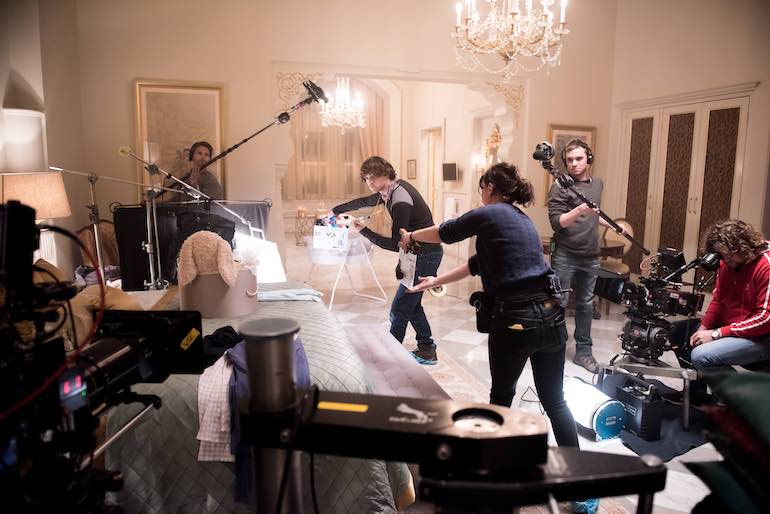
On set at Adelaide Studios during the filming of Hotel Mumbai.

Anthony Maras, who is well-known for his 2011 short film The Palace, spent a year researching and interviewing survivors and co-wrote the film alongside John Collee. The film stars Dev Patel, Armie Hammer, Nazanin Boniadi, Jason Isaacs, and Adelaide actor Tilda Cobham-Hervey and received a standing ovation at its world premiere at the Toronto International Film Festival last year before its Australian premiere at the Adelaide Film Festival.

Julie Ryan who heads Adelaide production company Cyan Films was one of six producers on Hotel Mumbai and says about 230 people were employed during filming and post production, with 66% of them from SA.

Although the Glenside film precinct is a world away from the Taj Mahal Palace Hotel, Julie says the set was adaptable in replicating the hotel’s interior.

Director Anthony Maras, centre, on set.

“Given the Adelaide Studios were built in the late 1800s – and the Taj was early 1900s – it meant that some of the architecture could match and we could build the sets and utilise things like the window frames and high ceilings,” she says.

“The studios and tenants were extremely adaptable and helpful, particularly the tenants on the second floor who allowed us to film in their corridors outside their offices.

“There are moments in the film where you come out of a corridor in Adelaide and literally walk into a set in Mumbai – and that’s the genius of (production designer) Steven Jones-Evans.”

Completing post-production and assisting in the execution of the seamless transitions between interior scenes in Adelaide and exterior scenes in India, was local company KOJO.

Dev Patel plays Arjun, a brave waiter at the hotel.

KOJO’s post production and VFX team was engaged in post-supervision, picture and sound services and VFX on the film, taking on additional staff to work on the project.

Executive director of KOJO’s post production/visual effects department, Marty Pepper, was Hotel Mumbai’s VFX supervisor and DI colourist.

Marty, whose portfolio of work includes Storm Boy, I Am Mother, and soon-to-be-released Top End Wedding met director Anthony Maras back in 2005 when working on Wolf Creek.

Actor Angus McLaren plays Eddie.

He describes Hotel Mumbai as an “all-consuming project” after being involved from pre-production stages and travelling to India three times during filming.

“It was a very holistic thing, I feel as if I almost lived it (the film) for those years,” he says. “There is an incredible sense of respect in the film (for victims and survivors) and that was led by Anthony.”

KOJO worked on 750 shots in the film, with the company’s entire post-production and VFX team involved “in some shape or form”.

“When we shot at Adelaide Studios the art department was quite incredible in turning the space into a luxurious hotel, and we played a part in how that was all integrated into the scenes in India. Part of the VFX was making sure the light and colour transitioned seamlessly,” Marty says.

Tilda Cobham-Hervey on set.

Hotel Mumbai is one of a string of films recently made in SA, a state which producer Julie Ryan and KOJO’s Marty Pepper both say punches above its weight in the film industry.

Julie notes the representation of SA films at this year’s Sundance Film Festival, with four of the six Australian films screened at the event having a connection to SA – I Am Mother, Animals, The Nightingale and Top End Wedding.

“When you look at the recent Sundance Film Festival and add up how many of the Australian films had connections to SA it really does show that we are punching above our weight,” she adds.

Industry in focus: Creative Industries

Throughout the month of March, the state’s creative industries will be explored as part of I Choose SA.

South Australia is home to a thriving ecosystem of creative businesses and specialists who are delivering world-class works VFX, TV and film production, app development and the VR space. Read more creative industries stories here.

Visit I Choose SA to meet the people building business and industry in SA, and to find out how your choices make a difference to our state.

[logooos_saved id=”13411″]

[logooos_saved id=”36524″]

Meet the chefs leading SA’s food waste movement

Banana peels, vegetable skins and corn husks aren’t ingredients typically associated with fine dining but local chef Kane Pollard is on a mission to change the way we think about food waste. He’s the head chef and owner of Topiary, a restaurant that’s nestled amongst towering gum trees in Tea Tree Gully.

He’s worked there for nine years and owned it for seven, successfully transitioning it from a cafe that sold sandwiches and scones to an award-winning restaurant that’s leading the charge when it comes to the South Australian food waste movement.

The Topiary’s housemade halloumi and its ricotta, semi-dried tomatoes and garden basil.

Everything you eat at Topiary is made on the premises – the butter, cheese, cured meats and fish, sour cream, yoghurt, all the breads, mustard – but Kane doesn’t stop there. Everything that’s bound for landfill is given a new purpose: corn husks become a malty corn bisque soup, excess sourdough starter is turned into a flaky tart shell, the stones from fruit are used to infuse oils and vinegars, and whole bananas are roasted in their skins and turned into a banoffee parfait.

“A good example is the cheese making process, during which you separate the curds from the whey,” says Kane. “It’s a long process and to discard three quarters of the total volume seemed nuts.” Kane and his team experimented with reducing the whey down and turning it into a caramel, and also using it in place of water to brine meats.

“Now, we add milk and draw the ricotta out of it, and serve it alongside the cheese that it came from,” he says. “So on the menu we serve ‘halloumi and its ricotta’, and the combination of the fried, salty, chewy cheese and the light, fluffy, sweet ricotta is incredible. It still blows my mind that they come from the same pot.”

The Topiary’s whole grilled eggplant, cultured buttermilk, cured yolk, and society garlic.

Kane’s not the only SA chef who’s putting waste on their menu. Tom Tilbury at Coriole restaurant Gather aims to operate a zero waste kitchen, with a stringent ban on single-use plastics and an expanding menu of dishes that use the whole animal and vegetable.

“All of our pork offcuts that don’t get used are cooked down, shredded and turned into a creamy pork rillette,” says Tom. “It’s served on a puffed bread cracker that’s made out of the odds and ends of sourdough. We soak it down, puree it and then deep fry until it puffs up. Absolutely no bread in our kitchen goes to waste.”

That mindset is echoed by a growing number of restaurants in the CBD, including regional Thai restaurant Soi38, South African BBQ hotspot Africola and Asian grillhouse Shobosho, who repurpose ingredient waste from Maybe Mae and the Shobosho kitchen into their cocktail list.

Coriole Gather’s pork rillettes, apple, savoy cabbage, sourdough crackers.

“There’s no such thing as waste – it’s just another ingredient,” says Africola’s head chef Duncan Weldemoed. Take their much-loved cauliflower steak: all trim goes in a pot, is cooked down and turned into a puree used to dress the steak. Their romesco pepper and barbecued carrot dishes are also marinated using trimmings that would otherwise end up in compost.

For Soi38 owners Terry Intrarakhamhaeng and Daisy Miller, the obsession with using waste started with mushrooms. “We use a lot of mushrooms in our curries and stir frys, and had all these stalks leftover,” says Daisy. “So we cook them down with peanuts and pickled sweet radish and turn them into dumplings.”

Africola’s head chef Duncan Weldemoed.

SA isn’t just leading the war on waste in the kitchen; the state is also home to a new national research centre created to combat Australia’s $20 billion food waste bill. Dr Steven Lapidge, CEO of the Fight Food Waste Co-operative Research Centre (CRC), says SA was the “natural home” for the centre.

“From container recycling to banning plastic bags, SA’s been a leader in sustainability for a long time. We also have the lowest food waste per capita,” he says.

Steven says dozens of initiatives are already taking place across the state: at the University of Adelaide, the 40% of potatoes that are graded out for cosmetic reasons are being turned into products like puree, dairy-free ice cream and vodka.

“SARDI (South Australian Research and Development Institute) is working a lot with the seafood industry,” says Dr Lavidge, “particularly with lobster waste, which they’re turning into lobster oil and powder for other foods.”

Minister for Primary Industries and Regional Development Tim Whetstone, left, Interim Dean of Waite Campus Associate Professor Chris Ford, Dr Steven Lapidge and Food SA CEO Catherine Sayer at the Waite Campus for the State Government’s announcement of the Fight Food Waste CRC.

CRC’s mission is to grow these initiatives by identifying businesses with troublesome waste streams and assigning them dedicated research resources to help find ways to stop food ending up in landfill.

For waste to be taken seriously by diners, aesthetics plays a big part, says Kane of Topiary.

“We want waste to be the key ingredient, rather than just making sure it gets used,” he says. “That means the dish needs to not only taste exceptional but also look beautiful. We want to change perceptions.”

Join Kane for a five-course dinner that showcases his zero-waste approach at his Tasting Australia event, Waste Not Want Not. $60, 6.30pm, Topiary. Tickets on sale now.

Main image features Topiary head chef and owner Kane Pollard.

Visit I Choose SA to meet the people building business and industry in SA, and to find out how your choices make a difference to our state.

[logooos_saved id=”13411″]

Blockchain’s next links – from online games to government documents

Blockchain has been an ambiguous technological concept in the minds of many – despite great excitement about its potential and enthusiastic recent spruiking by the South Australian government.

Now its function has gained some clarity for mainstream audiences through being used as a pivotal component within an innovative online game being devised in SA.

Forever Has Fallen is a conspiracy thriller game that will be played across different media types such as social media, websites, mobile and real-world events such as scavenger hunts and escape rooms.

The game will use blockchain technology to register ledger functions that players use to verify where they are in the game, along with ownership of digital goods and collectibles, and issuing rewards for completing tasks.

The attractive function of blockchain is that it allows digital information to be distributed but not copied. It serves an incorruptible digital ledger of separate blocks of information that are chained together in sequence, time stamped and managed by a cluster of computers rather than a single entity.

Blockchain is a pivotal component of the locally developed online game Forever Has Fallen.

Therefore, no centralised version of this information exists for a hacker to corrupt, making it an especially secure system for transferring financial transactions and confidential documents.

Originally devised for the Bitcoin digital currency, blockchain is now being applied by tech companies to serve other functions – with Adelaide-based marketing and communications entrepreneur Kimon Lycos being the first to apply it to entertainment and gaming with Forever Has Fallen.

Hoping to re-imagine the blockbuster screen entertainment format, Kimon has worked with his development team to present an interactive game that involves direct interaction with story characters, challenges and puzzles. At the game’s core will be Forever Coin digital tokens, a form of digital currency that will rely on blockchain technology to track and authenticate tokens used by game players.

“Our model is far more cost-effective at producing blockbuster storytelling than a conventional Hollywood movie franchise,” says Kimon. “We will be able to fuse the entertainment with game-like challenges that reward fans, and there is an entire economic system integrated within the story, where fans can buy, earn, trade and sell.”

Forever Coin digital tokens rely on blockchain technology.

While Kimon had initially planned to sell Forever Coin tokens by issuing SA’s first Initial Coin Offering, he has now abandoned this means of selling tokens. Instead, his company is planning to launch the Forever Has Fallen game concept via a podcast. He estimates that the company is about six months away from launching its podcast pilot.

“This is a digital democracy – truly interactive and live to all parties at once – which is why gamers in particular are excited by its implication,” says Kimon.

This wider application of blockchain being used beyond Bitcoin is, in the view of Kimon, the start of a fast-moving tech phenomenon. He sees the uptake of blockchain technology having a huge effect in government administration.

“Governments can address the challenges of trust and transparency while meeting the need for data protection and privacy,” Kimon says.

The thriller conspiracy game is based on a blockbuster story.

He points to Sweden’s land registry authority, the Lantmäteriet, wanting to allow buyers, sellers, banks and authorities to track a transaction from beginning to end digitally instead of using paper contracts, thus making tracking and transparency easier, because every party has information always accessible on the blockchain.

“The Dubai government is going all in. It wants all government documents secured on a blockchain by 2020,” says Kimon.

“It estimates its blockchain strategy has the potential to generate 25.1 million hours of economic productivity each year in savings, while reducing CO2 emissions.”

In a provocative article titled Death of the Bureaucrat published by the Hackernoon website, Kimon has written that “we can look forward to a revolution against governments and ironically enough it will be led by governments themselves”.

“This will be thanks to globalisation and a need for countries to be competitive in the struggle for talent, tax revenues and innovation to maintain prosperity.”

Forever Has Fallen founder Kimon Lycos.

However, the need for substantial computing power to realise all of blockchain’s potential uses means that many of blockchain’s more ambitious ideas are running ahead of current online capabilities.

“We are probably still five years away from having the readily available computing power to do all the blockchain things that people are talking about, because we don’t have the necessary storage, bandwidth and processing speeds of devices,” says Kimon.

“I liken this to the early days of the internet, when it took several leaps in the advancement of hardware and accessibility to reach where we are now. I think blockchain is on that same upward trajectory.

“Government can supercharge our competitiveness in blockchain technology,” adds Kimon. “Breakthroughs in new technology only come via support to make great leaps – and I believe that creating a world-class developer centre for excellence would result in SA having great exportable capabilities with blockchain, which is going to be enormous on a global scale.”

Check out the Forever Has Fallen trailer below! Contains very mild language and violence themes.

Industry in focus: Creative Industries

Throughout the month of March, the state’s creative industries will be explored as part of I Choose SA.

South Australia is home to a thriving ecosystem of creative businesses and specialists who are delivering world-class works VFX, TV and film production, app development and the VR space. Read more creative industries stories here.

Visit I Choose SA to meet the people building business and industry in SA, and to find out how your choices make a difference to our state.

[logooos_saved id=”13411″]

[logooos_saved id=”36524″]

Adelaide’s Floodlight to illuminate interstate

Remember that television commercial showing a couple on the couch being transported to the Bahamas? Well, the Adelaide creative team behind its making is now doing some teleporting of its own.

Video and film production company Floodlight Media is opening a new office in Melbourne later this month as its staff numbers swell to meet ongoing demand.

“We found Adelaide an amazing launching pad for our business and that it continues to be an ideal place for an head office,” co-founder and creative director Cameron Roberts says.

“The city punches well above its weight in the big names it attracts to the state, and being here meant we were able to prove ourselves on a less competitive stage. It wasn’t long before clients were asking us to fly to the other states to create their content for them.”

The team started in 2015 and specialises in advertising, creative production, corporate video, online live streaming and event coverage, and Cameron says being based in the studios run by the South Australian Film Corporation in Glenside is a great fit.

“Adelaide Studios is a fantastic community and it’s great to be rubbing shoulders with the people based here,” he says.

The Floodlight Media team in its early days when the four team members once worked in close proximity. Floodlight has come a long way since then, expanding interstate.

Many among Floodlight’s clients are now from the global renewable sector including Tesla, Siemens, AGL and Neoen – after the company, established by Cameron and his brother David Roberts, also recently bought another business specialising in the sector, New Era Media.

There are many other sectors they cover including recently providing the live streaming for the Lifesaving World Championships in Glenelg and producing its television content to distribute worldwide.Then there are a number of festival nominated short films including Fisheries Cops featuring Triple J’s breakfast co-hosts Ben and Liam.

Floodlight Media started out when Cameron finished studying film and television at TAFE and joined forces with his brother David – who has 10 years experience in the film industry including working on the popular Offspring television series, 100 Bloody Acres, Sam Fox Extreme Adventures and Red Dog.

When the first projects came up Cameron says neither thought Adelaide was capable of sustaining a full-time business in their field. But they were pleasantly surprised, work snowballed, and in 2015, David met Justin Counihan at the Australian International Pedal Prix.

Floodlight Media in action on an Adelaide Studios green screen shoot of a People’s Choice Credit Union commercial via KWP!

They recognised Justin’s important background in project management, he was installed as managing director and the company was formed. It did not take long for the company to quickly expand, moving from working in a spare room in a share house in the Adelaide Hills to an office at the Adelaide Film Studios hub.

In fact, the team has doubled every year for the last three in a row.

“We now have about 15 staff, we quickly grew out of our first small office and we’re now onto our third at the studios,” Cameron says.

The largest sector of work is in commercial videos for large organisations, and then there are TVCs, including that People’s Choice Credit Union commercial mentioned earlier.

Floodlight was approached by the Adelaide creative company kwp! to help with the credit union advertisement where two people sitting on a couch are transported to a renovated home and the Bahamas by swiping their iPad.

“That was a great project, we landed the VFX work, the backgrounds are completely built in a visual effects 3D space and animated,” Cameron says.

Floodlight Media (jokingly) tries to get into the Melbourne headspace by perfecting avocado lattes ahead of the move. From left, Trent Ninos (VFX), Emily Brockbank (camera operator), Marko Leosk (creative), and Holly Howard (head of production).

Other projects include ongoing work with UniSA, and working with JCDecaux to create a series of promotional videos for the 2017 Toyota AFL finals series.

JCDecaux developed live-link billboards, through which AFL stars could interact with fans, giving them the chance to win their way to the 2017 finals series. The campaign has been viewed over 500,000 times on social media with thousands of shares and comments. There’s also been work with Bendigo Bank, Australian Fashion Labels and the RAA.

“Given the business initially grew entirely from word of mouth, it was clear to us that our SA clients really appreciated our passion, quality and commitment to their product,” photography director David says.

Opening the Melbourne office on March 25 is about expanding the client base.

“We were surprised to find that our approach to film production was in high demand in Melbourne and we increasingly found clients willing to fly us over despite the fact the city has a lot of great production companies,” managing director Justin says.

“So it felt like the natural next step to officially set up shop there to be supported by our Adelaide head office.”

Industry in focus: Creative Industries

Throughout the month of March, the state’s creative industries will be explored as part of I Choose SA.

South Australia is home to a thriving ecosystem of creative businesses and specialists who are delivering world-class works VFX, TV and film production, app development and the VR space. Read more creative industries stories here.

Visit I Choose SA to meet the people building business and industry in SA, and to find out how your choices make a difference to our state.

[logooos_saved id=”13411″]

[logooos_saved id=”36524″]

The man who took on Mt Gambier’s tower in the clouds

As a mobile travel agent, Ben Deering’s office can be anywhere with Wi-Fi and a laptop, so why not make it on top of a mountain?

Mt Gambier’s Centenary Tower had been closed for two years when Ben volunteered to become its caretaker shortly after relocating to the regional city from Melbourne with his young family.

“I kept asking people why such an iconic building wasn’t open; you can’t leave it shut!” he said. “In the end, I had to put my money where my mouth was and agree to take it on myself.”

Ben Deering took over Mt Gambier’s iconic Centenary Tower two years ago and it’s since turned into a busy tourist attraction. Photo by Ockert le Roux.

Opened in 1904, the tower was built to commemorate 100 years since Mt Gambier was first sighted and named by Lt. James Grant aboard The Lady Nelson. Every morning, Ben takes an invigorating hike up the volcano slope to raise the flag signalling that the castle in the clouds is open.

“It’s a beautiful spot to stop and contemplate life; if you got sick of this view, I think you would need a bit of a hug, because this is pretty good,” he says.

After 14 months at the helm, it’s clear that Ben’s unique brand of energy has brought the 114-year-old landmark back to life, with visitors from across the globe soaking up the epic view of the surrounding crater lakes and beyond.

Stunning views from the top of the Centenary Tower.

“Some come up here and say they have been in Mt Gambier for two hours, and others say they have lived here for 20 years and have been meaning to get up here,” Ben says.

Word-of-mouth is proving invaluable, but social media has been another critical tool to boost visitation, with Ben’s Centenary Tower Instagram page attracting a growing number of followers.

“Instagram is a very visual platform, and we have a lookout, so that’s a great synergy, and I also have the advantage that I’m sitting up here for hours and can wait for the right light,” he smiles.

The Centenary Tower offers panoramic views of Mt Gambier and surrounds. Photo by Ockert le Roux.

Earlier this year, a dedicated group of 34 yoga buffs saluted the sun rise during a dawn yoga session at the tower, while an enthusiastic group of photographers often visits to capture incredible images of the night sky. Ben has also recently teamed up with a local chef to trial private balcony dinners.

“The view is the mainstay, but I’m trying to do a few experiential things around it,” he says. “I’m a volunteer who charges $2 for an adult a $1 for kids, so there is no marketing budget and you are forced to be creative.”

During the tower’s quiet patches, Ben dons his other travel hat, booking itineraries abroad for corporate clients in Adelaide and the eastern seaboard.

“I’ve spent the best part of the last 14 years sending Australians overseas, so it’s funny that I’m now also selling ‘local’, but it’s a familiar dichotomy bouncing back and forth between the roles,” he says. “I really just think it’s about getting people to live rather than just be alive.”

The tower is open when the flag is flying. Photo by Ockert le Roux.

Got a good story idea? Nominate a story from your region.
Click here to nominate >>

These inspiring regional stories are made possible by:

Major Partner[logooos_saved id=”5491″]Program Partners

[logooos_saved id=”29687″]

VFX studio Resin reaching new heights as projects soar

Post production rebates, revolutionary high-speed internet networks, and a growing reputation for world class visual effects (VFX) work are just some factors Adelaide studio Resin says is boosting business.

The opportunity to grow at the small VFX studio specialising in long-form series and feature film VFX has prompted the Adelaide born and based Resin to branch out and open offices interstate.

At the end of 2018, Resin expanded with a new business partner to open studios in Melbourne and Brisbane, a huge feat for the relatively small business and its 14 staff and portfolio including the 2019 Storm Boy, Electric Dreams, Red Dog and Netflix series Tidelands.

The business’s founders, VFX supervisor Grant Lovering and VFX producer Lincoln Wogan, say Adelaide is a great location to co-ordinate production between the teams Resin is building in the other studios.

“The expansion opens up access to more projects coming into Australia and will enable more face time with less travel to be with our clients in those locations,” Grant says.

Resin was the primary VFX vendor for the beloved Storm Boy remake, creating a digital double of the famous pelican Mr Percival, along with ocean and storm VFX.

Resin’s VFX producer Lincoln Wogan, left, and VFX supervisor Grant Lovering are Brand South Australia’s latest I Choose SA ambassadors. Photo by JKTP.

“Virtually anything you see on TV, in a series or on film, will have VFX in it,” Lincoln says. “Sometimes it’s as simple as they’ve shot at a particular location and all the signage needs to be removed, to changing a half-built location in a studio set to a dense jungle.

“Sometimes it’s simulating something too dangerous to do practically, but the most common requirement is to fill in the gaps to make the audience believe what is presented to them on screen no matter how unbelievable that may be.”

Despite Resin’s work ending up on small screens and cinemas nationally and worldwide, the business’s founders say Adelaide will remain as the headquarters.

“Fortunately the opportunity to do this work from any location means we don’t need to relocate to Los Angeles,” Lincoln says. “Regular visits make me appreciate Adelaide’s five minute commute to the studio.”

VFX supervisor Grant agrees, adding that the rollout of the city’s Ten Gigabit ultra-fast fibre optic network has been a tremendous benefit, however, it’s the state’s sound training facilities and VFX education courses training the next generation of VFX professionals that is helping grow VFX as an industry in Adelaide.

“For the younger generation that’s coming through now, there are heaps of good (VFX and post production) courses available in SA through our universities and private education institutions,” he says.

“We have great training facilities all around us and we have brilliant physical infrastructure that allows us to compete internationally.”

A shot from TV series Electric Dreams (Sony Studios).

SA’s Post Production, Digital and Visual Effects (PDV) rebate is also making Adelaide an attractive place for large budget international productions.

The offset sees companies receive a 10% rebate on their SA expenditure. Combined with the Federal Government’s PDV offset of 30%, international films can apply for a total combined 40% rebate on expenditure on post production, digital and VFX works on eligible projects.

Resin was born in 2006, with Grant and Lincoln partnering to create a post-production and VFX studio specialising in television advertisements. The work was consistently flowing and in 2010 Resin began working internationally for clients including Disney and Braun over a two to three year period.

Despite the distance between SA, the US and Europe, Resin continued effortlessly to base itself in Adelaide and complete all works from its small studio with about 17 staff at its peak.

But due to an economic downturn in the US and with the Aussie dollar soaring, international work for Resin began to contract and so the business focused itself on more local projects.

Resin’s Lincoln Wogan, left, and Grant Lovering, with the digital double of Storm Boy’s famous pelican Mr Percival.  Photo by JKTP.

By 2015, Resin had completed a few TV and film projects, including film Red Dog, when it became the sole VFX vendor for US series Hunters, with executive producer Gale Anne Hurd of The Walking Dead and Terminator franchises.

“At the end of that project we came away knowing this was our future … we pieced together that production in advertising wasn’t a growing market, shifts were happening,” Grant says.

“We were in the emergence of Netflix and all the other streamers as well so it was quite a good opportunity in the marketplace.”

With an increase in streamed content creating a demand for long-form VFX work, Resin changed its focus to rely solely on TV and film work, joining Ausfilm and focusing itself in LA. That focus led to the opportunity to work on Sony TV series Electric Dreams, an anthology of stories from Philip K Dick (Bladerunner). Resin travelled to Chicago and completed on-set supervision and VFX on two episodes, while also working on The Tick (Sony) and Queen of the South (Fox).

Growth at Resin has been on a healthy upward climb over the past three years. Grant and Lincoln say they are preparing for work to “explode”.

“We’ll need to make a decision about how much we want to grow in the next 12 months with some great projects lining up, it’s that significant,” Grant says.

Grant Lovering and Lincoln Wogan are Brand South Australia’s latest I Choose SA ambassadors for creative industries.

Industry in focus: Creative Industries

Throughout the month of March, the state’s creative industries will be explored as part of I Choose SA.

South Australia is home to a thriving ecosystem of creative businesses and specialists who are delivering world-class works VFX, TV and film production, app development and the VR space. Read more creative industries stories here.

Visit I Choose SA to meet the people building business and industry in SA, and to find out how your choices make a difference to our state.

[logooos_saved id=”13411″]

[logooos_saved id=”36524″]

Mission control, space discovery centres announced for Adelaide

The space industry is set to further take off in South Australia’s capital when a Mission Control Centre and Space Discovery Centre are established alongside the new Australian Space Agency.

The Mission Control Centre will provide a focal point for orbiting spacecraft and will be established alongside the national space agency within innovation precinct and former Royal Adelaide Hospital site, Lot Fourteen.

The Federal Government today announced a total $12 million investment into the nation’s space industry, including $6 million for the Mission Control Centre, and $6 million towards establishing a Space Discovery Centre, also at Lot Fourteen.

The funding will form part of the yet-to-be finalised Adelaide City Deal which is designed to boost the city’s population and drive economic growth.

Federal Minister for Industry, Science and Technology Karen Andrews says the Mission Control Centre will complement the work of the Australian Space Agency.

“The Mission Control Centre will be a focal point for space missions in Australia, providing facilities to control small satellite missions, enabling real-time control and testing and accelerated development of Australian satellite technology,” she says.

“It will be available for use by space start-ups and small-to-medium enterprise space businesses, as well as research and educational institutions from across Australia.

“These investments will help the Australian Space Agency foster the growth of a globally competitive space industry, worth about US$345 billion.”

An artist’s impression of Lot Fourteen once fully redeveloped. Photo: Renewal SA.

The Space Discovery Centre will provide science, technology, engineering and mathematics (STEM) education, engagement and inspiration for young Australians, and activities such as mission simulation and training for university students.

SA Premier Steven Marshall told ABC Radio Adelaide on March 18 that youth in the state were already excited about the career and education prospects the Australian Space Agency will create.

“When I’m out speaking to people, especially young people, they’re pretty excited about this opportunity to have this facility here in SA,” he says.

“You speak to university students … they’re all talking about the space agency … when you have a focus on space it actually lifts people’s aspirations around studying STEM subjects at school, which has a flow-on effect for plenty of other industries around our state.”

Both the Mission Control Centre and Space Discovery Centre will complement the work of the Australian Space Agency, which is set to be up and running by mid-2019.

The national agency was established in July 2018 with a Federal Government investment of $41 million over four years. The government plans to triple the size of Australia’s space industry to $12 billion and create up to 20,000 new jobs by 2030.

In December 2018, it was announced that Adelaide had won the bid to host the agency, expected to allow Australia greater access to the US$345 billion global space sector.

Visit I Choose SA to meet the people building business and industry in SA, and to find out how your choices make a difference to our state.

[logooos_saved id=”13411″]

Embracing the new technological frontier starts in SA

Artificial intelligence and machine learning are the great engines of change driving the Fourth Industrial Revolution – or Industry 4.0, as it is commonly called – and Adelaide has quickly positioned itself as an important hub for helping businesses implement the great challenge to adapt and innovate.

This has resulted in local companies automating tasks from screening for urinary tract infections to monitoring pests inside horticultural greenhouses, using innovative computer programs and machines that have been invented locally.

The Australian Institute for Machine Learning (AIML), located on North Terrace but soon to be relocated within the Lot Fourteen innovation hub (the former Royal Adelaide Hospital site), offers South Australian businesses the chance to be early machine learning adaptors.

Having emerged in early 2018 from the University of Adelaide’s Australian Centre for Visual Technologies (ACTV), led by global expert in video semantics Professor Anton van den Hengel, the AIML has received $7.1 million funding from the State Government (in addition to $5 million invested by the University of Adelaide) to work on such programs as improving traffic flow, defence projects and assisting the progression of emerging small and medium-sized enterprises.

The AIML is ranked third in the world in computer vision research. Its work is also focused on applying research outcomes to industry.

The institute’s impact and influence is growing rapidly. In the decade since ACTV began and morphed into AIML, the team has grown from five people to more than 100, including the brightest minds emerging from the university’s mathematics and computer science courses.

While a third of AIML’s work pursues pure research, which has it currently ranked third in the world in computer vision, it also focuses on applying research outcomes to industry needs.

“This research is keeping us ahead of the curve. Technology has a six-month cycle before it takes the next leap – it truly is moving that quickly,” explains AIML business development manager Paul Dalby. “Most organisations can’t afford to staff this, so we have the pool of talent they can draw upon.”

AIML researchers and technicians are trying to teach machines new ways of solving complex manufacturing and industrial problems, training computers how to do tasks on their own through deep learning programs, and implement faster ways of completing tasks.

LBT Innovations was among the first SA-based businesses to achieve commercial outcomes from working with AIML. The company, which focuses on clinical microbiology, initially went to ACVT in 2010 with the idea of automating the reading of inoculated petri dishes while screening for urinary tract infections.

CEO of LBT Innovations Brent Barnes.

This is a time-consuming task for scientific specialists that mostly registered negative readings, and after extensive research, testing and trials, LBT had its own patented machine (the Automated Plate Assessment System) ready for international sale by the end of 2018.

“It’s not a speedy process to develop an original idea – creating and testing something that is not an off-the-shelf algorithm – but now we have arrived first in this part of the global healthcare market,” says Brent Barnes, CEO of LBT Innovations. “It’s great that we have been able to initiate this world first from Adelaide.”

Machine Learning can also take effect at more simplistic levels for businesses. AIML has supported graduate Jordan Yeomans to launch his company Advanced Innovations, which is helping farmers growing vegetables in greenhouses at Virginia, just north of Adelaide.

He has switched their pest monitoring from a manual to automated system, using smartphone links to custom-designed AI computer software.

The success of this process – which Jordan estimates saves about 20 hours of manual labor a week – will provide the springboard for Advanced Innovations to work with greenhouses around Australia.

Other early adopters taking advantage of this homegrown expertise include Maptek, Sydac and Signostics. AIML will also reinforce and improve leading SA organisations from SAHMRI to the renewable energy sector, ensuring they remain at the forefront of global attention and success.

However, beyond these success stories, more needs to be done and with urgency – 80% of small and medium-sized businesses in Australia are delaying adaptation of machine learning, while overseas comparisons show that the rush to make sustained investments in AI and machine learning has commenced in earnest.

“What AIML offers is a huge leg-up for SA business,” says Paul Dalby, “but at the moment, not enough are taking up this opportunity. We are doing more work with companies in Sydney and Melbourne, so we need more mid-sized companies to get on board and build now.”

AIML is offering training programs for company CEOs to be introduced to machine learning concepts and possibilities.

The first free event for this year is being held on April 10 at the University of Adelaide’s Nexus Building on Pulteney Street. (Register here).

“We want to initiate the conversation with SA business leaders to discuss what is possible, and what steps can be taken for their enterprises to move beyond existing boundaries,” says Paul.

“This is very important, because if some companies don’t take swift action in this very dynamic era of change, their business models could very quickly become obsolete.”

Visit I Choose SA to meet the people building business and industry in SA, and to find out how your choices make a difference to our state.

[logooos_saved id=”13411″]

Bowhill Engineering constructing a strong future for Murray Mallee

A small family business on the banks of the Murray River in the small town of Bowhill has been a major source of employment for the area for decades.

In the past 40 years, Bowhill Engineering, located 65km from Murray Bridge, has grown from a small local steel fabrication and construction business to a leading specialist in heavy and complex structural steel fabrication.

It’s worked on some of the biggest infrastructure projects in South Australia, including the construction of steel bridge girders for the Darlington Upgrade, a stage within Adelaide’s major North-South Corridor road project.

In 2014 and 2016 Bowhill was also contracted by the Department of Planning, Transport and Infrastructure to construct a series of steel hull ferries for the River Murray vehicular crossings.

Bowhill constructed steel bridge girders for the Darlington Upgrade.

Managing director Jeremy Hawkes says together these two projects were a turning point for the business, significantly boosting revenue and workforce numbers.

“Within 12 months we doubled our revenue … admittedly, we were coming off a lower base because the industry was so depressed,” he says.

“It was still a massive jump for us to make in a relatively short period of time and it put a lot of pressure on our existing staff.

“We had to try and find new staff, get them onboard, skill them up and also make sure they fit in with our unique culture. Now we have a highly skilled and really engaged workforce of 30-plus that I’m really proud of.”

After winning the contract in 2017 for the Darlington Upgrade, Bowhill Engineering constructed the steelwork for two 3000-tonne bridges, built entirely off their permanent site, in what was an Australian first for civil engineering.

Other past projects include the Wayville Pedestrian Bridge in Adelaide’s inner southern suburbs, a complex, three-dimensional bridge that was met with a tricky design requirements and a tight deadline.

Bowhill Engineering managing director Jeremy Hawkes.

Bowhill’s clients include major players, McConnell Dowell, Lendlease, LEED, and Laing O’Rourke, while the business prides itself on also supporting small local businesses through its supply chain.

“There is a local company at Mannum, TR Male Transport, who we have been using as our supplier loyally for about 40 years,” Jeremy says.

“I’m really proud of the fact that we’ve been able to support them for a really long period of time, consistently all the way through. We have drafting people at Monarto who operate with us almost exclusively and that relationship has existed for about 25 years and spans two generations.

“We’re SA-based so 99% of what we purchase is definitely from SA and we’re very proud of that. We also have a very strong focus towards Australian steel and making sure we’re contributing to a sustainable steel industry.”

Bowhill Engineering is renowned for providing significant employment for the town, including young apprentices. It takes on at least one apprentice a year, and at the moment has six metal fabrication apprentices and one business administration trainee.

The Oaklands Crossing is also one of Bowhill Engineering’s big projects.

“We had some research undertaken recently which found that Bowhill Engineering employs the same percentage of people in manufacturing within the Mid Murray Council area as Holden did in Adelaide’s northern suburbs at the time of the closure announcement,” Jeremy says.

“That’s a pretty impressive stat when you think about it because Bowhill is such a tiny place. It doesn’t make logical sense (for the business to be located at Bowhill) because there are no support industries around us and we’re somewhat isolated. But we’ve made it work by focusing on our strengths.”

With Bowhill going from strength to strength in recent years, an expansion is on the horizon. The business is planning to underground powerlines that run through the property to give it the space and capacity for a physical expansion that could spur 20 new jobs.

The undergrounding project is a large and expensive feat costed at about $1 million and will be made possible with a $350,000 grant from the State Government’s Regional Growth Fund, in addition to Federal Government support through the Building Better Regions Fund for a similar amount.

Bowhill Engineering’s future expansion will mark a new chapter for the business which dates back to the 1970s, with Jeremy’s parents Brendon and Averil.

The Bowhill Engineering team.

Brendon was a farmer with a knack for repairing and modifying farm machinery and equipment and so the mechanic workshop Bowhill Motors was born. Brendon turned the focus away from mechanics and towards local steel fabrication and construction in the 1990s, building on strong foundations of community, reputation and a positive attitude.

These values were instilled in his two sons, Jeremy and Simon, who both went on to play instrumental parts in the business’s success as they grew older.

But tragically in 2002, Simon was killed in a car accident at the age of 30. He left behind a legacy of bold thinking, strong work ethic and a dogged determination which has helped shape the business into what it now has become.

Family is still at the core of Bowhill, with Brendon and Averil still involved in the business alongside Jeremy and his wife Jodie, who have four children.

“I am genuinely excited for the future,” Jeremy says.

“The government support both directly through funding assistance and indirectly through a buoyant economy and infrastructure building creates an excellent opportunity for us to continue to foster growth in our people.”

Got a good story idea? Nominate a story from your region.
Click here to nominate >>

These inspiring regional stories are made possible by:

Major Partner[logooos_saved id=”5491″]Program Partners

[logooos_saved id=”29687″]

Lot 100: a thriving epicurean delight

In the middle of a cow paddock and beside an apple orchard in the Adelaide Hills, two very large, very modern sheds represent an exciting new development in how outstanding local epicurean fare is made and presented.

Lot 100 brings together a host of the brightest beverage and food talent in this state as co-habitants in a versatile production space and a huge, open plan tasting pavilion, located within the Ceravolo family’s 84ha property in the quiet Hay Valley, just outside of Nairne.

It’s the $4.5 million shared home of The Hills Cider Company, Ashton Valley Fresh juices, Adelaide Hills Distillery (producers of 78 Degrees gin), Mismatch beer and the storage facility for Vinteloper wines.

The size and scale of this smart collaborative venture has made an instant impression on hordes of visitors since Lot 100 opened in December 2018. However, most don’t realise this has been five patient years in the making – and that Lot 100 is determined to keep growing.

Lot 100 during the Adelaide Hills Crush Festival in January, 2019.

The latest step is to open a mezzanine bar in the production shed, built by carpenter Sam Weckert, above the amassed beverage production equipment. At spacious tables and benches, visitors will be able to participate in masterclasses, tastings and blend-your-own workshops presented by the various producers.

“These hands-on activities will be great fun, very educative and also give the participants a very clear idea of just how much production activity is happening inside this vast insulated shed,” says Lot 100 co-partner Toby Kline.

Participants will be exposed to a variety of new taste sensations, especially when presented with Adelaide Hills Distillery’s experimental Native Grain Project, which is working through trials of making spirits from such native ingredients as wattleseed, kangaroo grass and saltbush seed.

The epicenter of the production shed is Mismatch’s 35 hectolitre Premier Stainless brewhouse, which brewers Ewan Brewerton and Leigh Morgan installed and began operating a year ago, while the remainder of the facility was still being completed.

While the space is now humming with activity, there is still ample room for the producers to expand their operations. For instance, Vinteloper winemaker David Bowley continues to make his wines elsewhere in the Adelaide Hills, due to his preference for wild yeasts during fermentation posing a threat to the brewery’s production requirements – but he will store his wine barrels at Lot 100.

The open plan tasting pavilion.

A facility of this size needs significant resources to keep it operating, and its designers have addressed sustainability and efficiency issues at every step of its construction and operation.

The most expensive shed on the property is also the smallest – a $750,000 water treatment facility that extracts water from two bores, removes its salts and minerals via reverse osmosis, then feeds it into the shed for use by each beverage producer. Wastewater is fed back into the system, treated and then used to irrigate crops, grass and trees, including the Ceravolo family’s adjacent orchard, which produces fruit for Hills Cider and Ashton Valley Fresh Juices.

Spent grain from the distillation process is recycled as feed for local livestock and used in the Lot 100 kitchen to bake bread. Electricity used on the site is provided by 1700 square metres of solar panels, creating a sizeable a solar farm on the production shed roof.

While the visiting public doesn’t see this, they do get to sample a huge array of drinks in the company of food within the adjacent tasting pavilion. A bar with 40 taps is designed to swiftly serve big numbers of visitors, with 30 pouring Mismatch beers, six for Hills Cider and four for Adelaide Distillery spritz.

Pizzas are on the menu at Lot 100, as are smaller roasted dishes, local produce plates and pastas.

Adelaide design company Frame (which creates product labels for Mismatch and Adelaide Hills Distillery) has dressed the cellar door interior with raw timber slats rising to the high ceiling and polished-concrete floors. This room opens to broad timber decks and rolling lawns that accommodate many more diners and drinkers under the shade of towering gum trees.

A sustainability message follows through to food served in the cellar door dining area, prepared by chefs Shannon Fleming (formerly of Adelaide’s esteemed Restaurant Orana) and Tom Bubner (of Pizza e Mozzarella and Chicken & Pig). The menu is built around a relaxed Italian style of eating – from pizza to pasta and roasted treats from a wood-fired oven, but the intention is to place locally sourced ingredients on a pedestal.

More plans for Lot 100 are already in motion. Hop plants are growing, so their flowers can eventually be used in Mismatch beers, while a kitchen garden will provide a range of vegetables and herbs for the restaurant, to keep reducing the distance from paddock to plate. An eventual aim is for the cellar door to include produce sales as well as beverages – “a one-stop shop for everything delicious,” as Toby Klein explains.

The makers of 78 Degrees Gin, Adelaide Hills Distillery, operates at Lot 100.

Visit I Choose SA to meet the people building business and industry in SA, and to find out how your choices make a difference to our state.

[logooos_saved id=”13411″]

Got a good story idea? Nominate a story from your region.
Click here to nominate >>

These inspiring regional stories are made possible by:

Major Partner[logooos_saved id=”5491″]Program Partners

[logooos_saved id=”29687″]