SA film Storm Boy to reach global audiences

It’s the Colin Thiele classic that captured the hearts of a generation and now the story of the loveable boy and his pelican has returned to the big screen.

The much-anticipated re-imagination of the 1964 novel Storm Boy will hit Australian cinemas on January 17, bringing to life the adored tale of the adventurous South Australian boy and his pelican, Mr Percival.

The 2019 Storm Boy will also enjoy international releases across New Zealand, Singapore, Malaysia, Indonesia, the Middle East, Poland, Yugoslavia, Canada and the US.

The last time the Storm Boy story was brought to the screen was in the 1976 film starring Greg Rowe, Peter Cummins and David Gulpilil.

The Coorong region is again the backdrop for the 2019 remake, filmed entirely in SA using a mostly local crew as well as a number of local creative and film industry practitioners.
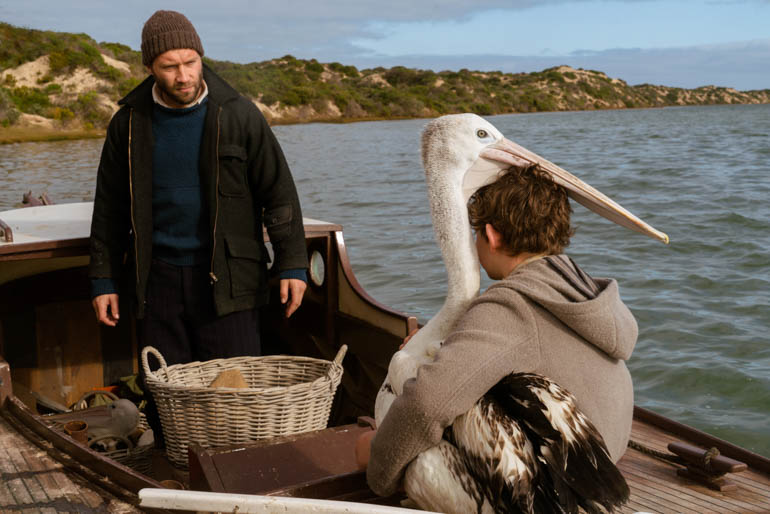
Jai Courtney, left, plays Hideaway Tom, while Finn Little plays the young Michael Kingley, holding Mr Percival.

The contemporary retelling features a grown-up Storm Boy, Michael Kingley (Geoffrey Rush), who has vivid flashbacks of his childhood, centred around his unbreakable friendship with orphaned pelican, Mr Percival.

Michael recounts to his troubled teenage granddaughter Maddie (Morgana Davies) the memories of his loner father Hideaway Tom (Jai Courtney), the friendly Aboriginal man Fingerbone Bill (Trevor Jamieson) and the how they raised three rescued pelicans.

The desolate and rugged coastal landscapes of the Coorong region are stretched across the screen, while the township of Port Elliot also features in the film.

Dramatic yet poignant scenes are complemented by natural recordings of the Coorong environment, and enhanced by pieces performed and recorded by the Adelaide Symphony Orchestra.

The cast and crew were based out of the SA Film Corporation’s (SAFC) Glenside studios, with filming also taking place in the Goolwa area and the Coorong National Park.

Fingerbone Bill (Trevor Jamieson) and the young Michael Kingley.

Storm Boy is an Ambience Entertainment production, with major production investment from Screen Australia in association with the SAFC.  The film’s post production involved the work of Adelaide creative agency KOJO and local VFX company Resin.

Storm Boy was producer Matthew Street’s first feature film shot in SA and he says he would have no hesitation about filming in the state again.

“SA has a highly respected industry with companies like Rising Sun and now Resin, these are world class visual effects companies,” he says.

“The good thing was working with the crew, they were a-list and would match anyone in the world.”

Matthew describes the 2019 Storm Boy as a “proudly South Australian film” and says he and fellow producer Michael Boughen set out to create a contemporary retelling of the classic story that would resonate with new generations and international audiences.

“Our main aim out of the story and the performance is that it would resonate globally. The human story just happens to be set on the Coorong, but it doesn’t matter in what language, it’s a story that should travel.”

Matthew says Storm Boy has brought many economic benefits including short-term business activity for the Fleurieu Peninsula communities during filming.

“We had all those people accommodated down and around the Coorong and Goolwa, so it (the benefits) spilled off into communities and secondary things let alone the tourism benefits nationally and globally for SA.”

As with all remakes and adaptations, the 2019 Storm Boy isn’t immune to the pressure of living up to the emotion, simplicity and beauty of the novel and first movie.

“We had a lot of pressure to make sure this re-imagination was worthy because there’d be a lot of critique beyond just the traditional film critique,” Matthew says.

“We weren’t going to make it unless we could deliver the heart and soul and emotional feeling you get from reading Colin Thiele’s incredible book.”

Storm Boy held its world premiere in Adelaide on January 6. It will be released nationally on January 17. Brand South Australia has teamed up with SONY to give 10 SA families the chance to see the film. Entries close January 14. Click here to enter.

Visit I Choose SA to meet the people building business and industry in SA, and to find out how your choices make a difference to our state.

[logooos_saved id=”13411″]

Community spirit fulfils Waikerie’s nature park dreams

A water and nature play park at Waikerie in South Australia’s Riverland demonstrates how a community can work together to achieve amazing results.

Local couple, Clive and Donna Matthews came up with the idea, after noticing how much their daughters, Evie, 9, and Arlee, 7, enjoyed visiting similar playgrounds in other towns during their caravan holidays.

The Waikerie Water and Nature Play Park blends in with the natural environment and the nearby River Murray.

“We were very specific about this, there is no blue or yellow,” Donna says.

The playground features a flying fox, a teepee, water play features, bench seats made from logs and stones, and a climbing wall. An old boat was donated by local car dealership, Sutton Ford and painted by the Waikerie Men’s Shed.

Waikerie couple Donna and Clive Matthews worked tirelessly to fulfil the community’s dream of a riverfront play park. Photo by Christine Webster

The playground has also been designed so it can be enjoyed when it is too cold for water play.

The park was officially opened on December 22, 2018, to coincide with the summer school holidays and it is already giving local families and tourists much joy.

Donna and Clive realised their dream of creating the park on the Waikerie riverfront had potential when they learned about the SA Government’s former Fund My Neighbourhood Grants (FMN) program.

The couple applied for funding from the program and were delighted to receive $150,000 for the park project.

The public also had to vote online for the project and the strong response from Waikerie residents resulted in the playground being one of the highest voted for projects back in 2017.

Clive says they thought they had hit an obstacle, when they learned they were unable to use the FMN money to apply for any further grants.

Zayn, 5, left, Rino, 4, and Lachlan 4, all of Waikerie try out the water pump for the first time at the official opening in December. Photo by Christine Webster

Parks with water elements require expensive underground works and more money was needed. But the town came to the rescue.

The Rotary Club of Waikerie donated $50,000, the Loxton Waikerie Council provided $30,000 of in-kind support in labour and the Waikerie Apex Club contributed $11,000 to shelters at the park.

Members of the Waikerie community and local businesses also donated a total of $15,000 after Donna set up a Go Fund Me campaign.

Clive, who runs a maintenance and installation business at Waikerie, also saved $30,000 by volunteering his time to project manage the park’s construction.

Donna, who has always been artistic and is a beauty therapist, also wanted to save money on having to engage a professional designer. She designed the play area after many hours of research, which included visiting play parks around Australia.

“Parents with young children worry all the time because the river can be dangerous, but at the park they can still get wet and it’s safe,” Donna says.

Adela Frankel, 8, of Berri, on the teepee, which is the park’s showpiece. Photo by Christine Webster.

Drought and downturns in the citrus and wine industries, which in recent years have begun to perform strongly again, have often left Waikerie struggling to maintain its population and town centre.

Clive and Donna believe the tide is gradually changing with several new businesses opening in recent weeks, with Clive saying tourism is the key.

Since the water and nature play park opened just before Christmas, about 3000 people have paused to enjoy the serenity of the riverfront and try out the playground.

“Waikerie is beginning to change and in the next few years I would love to see it boom,” Clive says.

Loxton Waikerie Mayor Leon Stasinowsky says the park is an example of what the community can achieve by working closely with the council.

“It is something I have always been passionate about,” he adds.

Header image: Photo by SkyTec Media.

 Got a good story idea? Nominate a story from your region.
Click here to nominate >>

These inspiring regional stories are made possible by:

Major Partner[logooos_saved id=”5491″]Program Partners

[logooos_saved id=”29687″]

Port Lincoln cinema saved from closure

When Port Lincoln woman Angela Perin heard that the town’s only cinema would close its doors on December 31 last year she saw an opportunity to save the much-valued community facility.

The Port Lincoln cinema had been run by youth social enterprise, Youthoria, under community organisation West Coast Youth and Community Support (WCYCS) for almost a decade.

But due to a lack of funds, Youthoria announced its looming closure causing disappointment among locals as the next closest cinema is three hours away in Whyalla.

“When the board announced that it was going to close the cinema I hoped that someone would grab it up and give it a new lease on life. But that didn’t appear to be happening and the community was really upset,” Angela says.

“I have two kids, aged 12 and 13, and we can’t imagine the town without a cinema. So I did what I’m always telling others to do and that is do something about it. I had a chat to my family we decided that we’d do it.”

Rudi Perin takes charge of the popcorn machine at the Lincoln Cinema.

As an employee at WCYCS, Angela was familiar with the running of the Youthoria cinema and had worked alongside  the youth group that took over the theatre in 2008.

She is now running the cinema as a family business, purchasing the cinema equipment from Youthoria and leasing the 90-year-old theatre building from the Port Lincoln Council.

On January 3 the movie theatre was revived under a new name, Lincoln Cinema, welcoming 200 movie goers through its doors and continuing the tradition of watching holiday blockbusters on the big screen.

“The community has been so supportive, people have come from Tumby Bay, Cummins and Cleve,” Angela says. “The support has been overwhelming.”

The Lincoln Cinema will close from January 29 until the end of February to undergo minor renovations, with Angela hoping to expand the candy bar to create a more welcoming coffee spot and meeting place for visitors.

The Port Lincoln cinema, originally known as Flinders Picture Theatre, was established in 1929. Photo courtesy of Cinema Treasures, Granola.

She says the cinema is an essential facility for regional youth as it offers them a safe place to meet and socialise.

“Going to the movies is an experience,” she says.

“You can watch movies at home but going to the movies with friends and family and seeing something on the big screen – there’s nothing like it.”

Longstanding SA movie theatre company Wallis Cinemas is the booking agent for Lincoln Cinema, which Angela says will screen some of the summer holiday blockbusters including Mary Poppins Returns.

The movie theatre on Hallett Place in Port Lincoln was established as the Flinders Picture Theatre in 1929 by Mrs R. L. MacGregor.

An article in the Port Lincoln Times newspaper on Friday, September 6, 1929, reports on the ceremony where the foundation stone was laid.

The article states, “It was recognised that a theatre of the class that was being built was essential to the progress of Port Lincoln. The hope was expressed that the venture would prove a success”.

Got a good story idea? Nominate a story from your region.
Click here to nominate >>

These inspiring regional stories are made possible by:

Major Partner[logooos_saved id=”5491″]Program Partners

[logooos_saved id=”29687″]

Adelaide-based SEAPA excelling in international markets

Existing outside the oyster industry has enabled Adelaide-based plastics fabrication company SEAPA to forge radical ideas that have revolutionised oyster farming systems and built a globally influential business.

The popularity of its innovative oyster harvesting baskets has seen SEAPA take out the Agribusiness Award and Australian Exporter of the Year Award at the 2018 Australian Export Awards in Canberra.

This underlines the company’s spiralling success, building on its 2018 Business SA Export Agribusiness Award for outstanding international success in the field of agricultural products.

“Our background is in plastics injection moulding – not oyster farming – so our strength has been forming close partnerships with primary producers and coming up with innovative solutions to their problems,” says Andy Will, SEAPA group general manager.

“The ability to adapt rather than impose our products on customers has made them more beneficial to specific needs.”

SEAPA group general manager Andy Will, left, accepts the Export Agribusiness Award from Trade, Tourism and Investment Minister Simon Birmingham.

Oyster farmers around the world have embraced SEAPA’s long, plastic mesh baskets that are laid horizontally in the water from adjustable long lines, which enables shifting ocean tides to rumble the oysters inside the baskets.

This marks a significant departure from the older fixed rack and rail system, involving growing oysters on fixed trays along submerged wooden rails.

SEAPA’s horizontal basket system provides the flexibility for farmers to adjust the height of baskets to accommodate tidal movements, encouraging more rapid growth and development of well-cupped oysters with a clean hard shell and high meat content.

“All of our customers want the same outcomes – higher quality oysters, produced with greater efficiency,” says Andy.

“They want a farming system flexible enough to react to different seasons and environmental conditions, so that’s what we have worked closely with them to design and manufacture.”

For this system and these radical ideas to enjoy success beyond South Australia’s Eyre Peninsula, where they have been trialed and successfully implemented, it has been necessary for SEAPA to be patient and strategic.

The oyster harvesting baskets in action.

Many countries that have employed the same oyster harvesting systems for centuries are wary of implementing change; France is very dogmatic about continuing traditional methods, Japan even more so.

“None of this happens overnight,” says Andy. “We have been in the US since the early 2000s, and more than a decade in France.”

“We have to make sure that the initial systems that we introduce into these countries are operating with optimal success in their farms, and we want their neighbours to notice that our systems involve a lot less labour and more impressive yields, because we know they need to see something in action before they believe it works.”

Since 2001, SEAPA has been exporting its range of products manufactured in Adelaide, with 75% of SEAPA’s revenue in the previous financial year coming from international markets.

Asia has emerged as a key buyer of SEAPA products, with significant sales progress in China, Japan and Korea stemming from the recent removal of prohibitive tariffs.

Continued growth in these markets represents a significant prize; while 13,000 tonnes of oysters are produced annually in Australia, 2.2 million tonnes are produced in China each year, and SEAPA’s footprint there is currently small but with the potential for rapid growth.

Technical innovation has been a pillar of SEAPA’s success, with its large range of 60 products allowing its oyster harvesting system to be used in almost any farming environment.

SEAPA group general manager Andy Will, left, managing director Garry Thompson and group sales manager Alex Jack.

SEAPA’s technological innovation is led by the design and manufacturing teams at its parent company, Adelaide plastic injection moulder Garon Plastics, which uses advanced design tools and 3D printing to rapidly develop and deploy new ideas for testing and refinement, giving farmers the tools they need, when they need them.

Being based in Adelaide has several advantages for SEAPA, from its established and progressive manufacturing plant, to performing extensive research and development through working closely with SA’s league of oyster farmers.

“We see the farmers that use our products as our partners in the design of the system. We wouldn’t be able to develop the products without their input,” Andy says.

However, having its head office and manufacturing plant located a long way from international markets means that SEAPA has needed to be nimble and strategic in forging its global sales network across 20 countries, benefitting from establishing local offices in its target markets across North Asia, Europe, and North America.

While SEAPA has already enjoyed a strong performance in the current financial year, Andy can see that global oyster eating trends are changing, with a rise in premium oyster bars in the US and Asia meaning that demand for excellent oysters in shell will increase, and therefore provide increased opportunities for the introduction of more of SEAPA’s innovative oyster basket systems.

“There is great success that we have enjoyed through the first 20 years of this company, but greater opportunities now lay ahead,” says Andy, “and we have to remain innovative and agile to make sure we can reap the benefits.”

Industry in focus: Trade and Investment

Throughout the months of January and February, the state’s trade and investment industry will be explored as part of I Choose SA.

South Australia is in a prime position for trade and investment opportunities as we have a 24-hour connection to international markets and a prime reputation for our premium products and services.  Read more trade and investment stories here.

Visit I Choose SA to meet the people building business and industry in SA, and to find out how your choices make a difference to our state.

[logooos_saved id=”13411″]

[logooos_saved id=”35109″]

Trade and investment sectors offer endless opportunity

A highly competitive business environment, a skilled and educated workforce and a culture of innovation are some aspects that make South Australia a prime spot for trade and investment opportunities.

Our state is often celebrated for its enviable lifestyle offerings and cost advantages matched by no other Australian state, providing the perfect platform for outside companies to invest and develop, and for homegrown businesses to grow and thrive.

SA also has a 24-hour connection to key international markets and a solid reputation for producing world-class products and premium services.

Throughout January and February, Brand South Australia is exploring the trade and investment sector, as part of its successful I Choose SA campaign.

Here on Brand SA News, we’ll bring you examples of businesses who have chosen our state as the base of their operations as well as success stories of those exporting their goods and services to the world.

We’ll also share articles on international businesses choosing to invest in SA, develop a presence here and take advantage of our highly skilled and educated workforce.

One example is German battery giant Sonnen, attracted to SA by its can-do attitude and its deep, technical manufacturing skills base developed from a long history in the automotive industry.

The official launch of Sonnen at the former Holden factory in Adelaide’s north.

It’s of course also relevant to note British steel magnate Sanjeev Gupta, owner of the Whyalla steelworks, and his plans for major investments and ambitious upgrades to the steel city. We’ll also tell you about SA businesses that have come under foreign ownership – companies like Pirate Life Brewing, Udder Delights and Mojo Kombucha.

Although their ownership has left SA, these three businesses are still based in the state but have the opportunity to expand, create more jobs and continue to deliver the premium products we love.

SA’s goods and services are valued by key international markets, thanks to our outstanding freight connections and cold chain logistics to South East Asia, the Middle East and within Australia.

As well as successful commodities such as iron, copper and energy resources, SA is renowned for its food and wine exports due to impeccable food safety standards. Other industries, including education, defence, advanced manufacturing and space, also have ties to our trade sector.

Among the most exciting investment opportunity is Australia’s Space Agency, to be developed in Lot Fourteen (old Royal Adelaide Hospital), boosting our capabilities in innovation and technology.

Interested to learn more about SA’s trade and investment industry? Head along to Brand South Australia’s Industry Briefing at the Adelaide Convention Centre on January 31.

Guests will hear from Minister for Trade, Tourism and Investment, David Ridgway.

What: Brand South Australia I Choose SA for Trade and Investment Industry Briefing
When: January 31, 4.30–6.30pm
Where: Adelaide Convention Centre
Tickets: click here to purchase

Industry in focus: Trade and Investment

Throughout the months of January and February, the state’s trade and investment industry will be explored as part of I Choose SA.

South Australia is in a prime position for trade and investment opportunities as we have a 24-hour connection to international markets and a prime reputation for our premium products and services.  Read more trade and investment stories here.

Visit I Choose SA to meet the people building business and industry in SA, and to find out how your choices make a difference to our state.

[logooos_saved id=”13411″]

[logooos_saved id=”35109″]

Why energy giant Sonnen chose to invest in SA

Global energy storage giant Sonnen is producing its first Australian assembled batteries at the former Holden factory in Elizabeth as its workforce builds to some 150 within months.

Operations and finance managing director Marc Sheldon believes South Australia is the ideal place for the German-headquartered company to work toward producing 10,000 batteries a year to meet demand in Australia and the neighbouring Asia Pacific region.

“The energy market as it exists in SA is unique, it is more advanced than any OECD country in its transition to renewable energy,” Marc says.

This, he says, gives the Sonnen company the opportunity to address challenges and be prepared for a market it expects to develop rapidly throughout the region in the next few years.

It also means Sonnen has established itself in a state where it has access to highly skilled workers and companies with a “can do” attitude.

Sonnen’s operations and finance managing director Marc Sheldon, left, Sonnen CEO Christoph Ostermann and managing director for Australia and Asia Pacific Nathan Dunn.

Marc says more than 50 local employees are already on the production line and almost all of them are ex-Holden staff – while another more than 100 are working as installers through the supply chain.

The company is well on the way to creating about 430 new jobs in the state within 18 months, he says, as outlined when the new Liberal State Government announced earlier this year that Sonnen would be moving into the repurposed Holden factory.

“What we do is advanced manufacturing in the purest sense, we leverage the innate capabilities in the market itself,” Marc says.

“We’ve indicated before that one of the key challenges for us when we are choosing a site is around availability of talent and availability of staff to fill those roles, what we’ve now really found is lots of well educated, well trained staff.”

Sonnen is supporting the new $100 million Home Battery Scheme announced by the State Government in September that provides a subsidy of up to $6000 per household to install home battery systems.

From October, 40,000 South Australian households have had access to the scheme designed to reduce electricity costs and demand on the network, in turn delivering lower power prices for all South Australians.

Sonnen CEO Christoph Ostermann, far left, shows Premier Steven Marshall, and Minister for Energy and Mining Dan van Holst Pellekaan, far right, Sonnen systems at the company’s official launch in SA.

The $100 million in State Government subsidies was also matched with $100 million in finance from the Clean Energy Finance Corporation to provide low-interest loans for the balance of the battery and new solar if required.

When the scheme was announced, Premier Steven Marshall said priority was being given to qualified system providers who commit to installing approved battery systems that are manufactured or assembled in SA.

Sonnen was the first provider to be afforded the nine-week priority period – meaning their products were exclusively available to households – with additional brands available after the nine-week period.

The company describes its world-leading sonnenBatterie as a high-tech energy storage system that automatically adjusts the energy usage in a household in combination with solar panels to provide clean, renewable energy.

“There’s a reason why we’re going to SA, we’re quite impressed with what the government has been able to put together since its election and the feeling we’ve received from people in SA is really good, there’s a can-do attitude,” Marc says.

“Businesses we meet with say we can do that right now or let’s sit down and see how we can make that happen … that makes us quite happy looking at the future.”

Minister for Energy and Mining Dan van Holst Pellekaan, left, and Premier Steven Marshall congratulate Sonnen CEO Christoph Ostermann, on the company’s establishment in Adelaide.

Sonnen will use Adelaide as its Australian headquarters and shipping centre for the Asian region, and Marc says the first SA assembled batteries to be exported will head to New Zealand in January.

The company aims to assemble and manufacture 50,000 energy storage systems at the site over the next five years, after its plans to establish the battery production plant in Adelaide were initially announced in February 2018.

Manufacturing costs are also now proving to be positive from the initial cost projected in pre-planning as Marc says there already had been an increase in productivity per head by 30% as the process was streamlined.

Sonnen has also appointed a new Australian managing director Nathan Dunn to support growth with Marc, who has worked for Sonnen for the past three years, saying there was much potential in SA.

“I think in South Australia everything is moving in the right direction and a lot of very interesting developments are happening right now that will benefit the state,” he adds.

Header image: The Sonnen Adelaide team. Photo by Danielle Marie.

Industry in focus: Trade and Investment

Throughout the months of January and February, the state’s trade and investment industry will be explored as part of I Choose SA.

South Australia is in a prime position for trade and investment opportunities as we have a 24-hour connection to international markets and a prime reputation for our premium products and services.  Read more trade and investment stories here.

Visit I Choose SA to meet the people building business and industry in SA, and to find out how your choices make a difference to our state.

[logooos_saved id=”13411″]

[logooos_saved id=”35109″]


Old Lucky Bay shop to reopen at centenary celebrations

It was 100 years ago that Eyre Peninsula farmers first created their own summer playground at Lucky Bay.

Escaping the hot dry interior with their families, canny farmers erected ramshackle shacks along a golden, but often seaweed strewn, stretch of sandy beach near Cowell.

Now, current generations of those pioneer families will return on January 12, 2019, to celebrate the centenary of the first shacks being built – and many of their beloved summer rituals will resume.

Lucky Bay beach in 1939.

Sue Chase, who is now president of the Lucky Bay Shack Owners Association, remembers in her childhood how she sat up on the counter of Cornelius’s Shop, a pop-up deli run by the Cornelius family that would only be open for five weeks after Christmas.

Wide-eyed and excited, she loved choosing individual favourite treats for her paper bag of mixed lollies. Much later, her children’s customary treats from the same shop were freshly buttered finger buns after completing their morning swimming lessons on the beach.

Her father had been a shop customer, too, and now Sue’s grandchildren will get a taste of the shop’s wares when Shannon Cornelius, son of the original operator, reopens the pop-up for the first time in a decade, as a pivotal part of the Lucky Bay centenary celebrations.

“Going to that shop became a symbol of summer for me, and having it open again will bring back a flood of happy memories for me and a lot other people who enjoyed their holidays at Lucky Bay,” says Sue.

New Years Eve Day, 1922, at Lucky Bay.

Other attractions on January 12 will include the Lions Club of Cowell moving its monthly foreshore market to the Lucky Bay beach.

A collection of Lucky Bay memorabilia and historical photos showing various shacks and beachgoers through the past 100 years will be displayed in the local hall – along with a nostalgic display of swimwear through the decades, which Sue explains will only be a static exhibition.

“We couldn’t get any volunteers who were game enough to act as models,” she offers with a chuckle.

While the pace at Lucky Bay remains slow, things have changed in the past decade, since a harbour was dredged nearby to accommodate the Wallaroo-to-Cowell ferry.

A family outside one of the first beach shacks at Lucky Bay.

This finally brought a bitumen road to Lucky Bay, which has increased the flow of traffic and attracted more day visitors.

The centenary celebrations will hark back to simpler times, especially an array of old-fashioned events being among organised beach sports activities, with three-legged races, a sandcastle building competition and egg and spoon races for children, and a giant tug-o-war and greasy pole climbing competition for adults.

The beach activities will be completed with an IronMan and IronWoman competition, kayak races, and a fishing and casting competition.

For full details of the Lucky Bay centenary celebrations, which will include a live music concert and fireworks display on the beach after dark, visit the Lucky Bay South Australia Facebook page.

Let us know via the Brand South Australia Facebook page if you have any old photos of Cornelius’s Shop.

Got a good story idea? Nominate a story from your region.
Click here to nominate >>

These inspiring regional stories are made possible by:

Major Partner[logooos_saved id=”5491″]Program Partners

[logooos_saved id=”29687″]

Festival provides a richer taste of French culture

There’s nothing so sensual, so essentially French as indulging all the senses around the finest food, wine and music.

This is why Valerie Henbest, proprietor of the Adelaide Central Market’s Smelly Cheese Shop, has created special events for the 2019 Adelaide French Festival, pushing boundaries with innovative creative concepts that combine multiple art forms with culinary pleasures.

As part of the French-accented cultural festival being held in and around the Adelaide Festival Centre from January 11–13, Valerie is curating Sonic Seasoning on January 13, teaming a performance by contemporary Adelaide string ensemble Zephyr Quartet with a structured champagne and cheese tasting on the Dunstan Playhouse stage, to test whether music can heighten appreciation of fine wine and cheese.

“I’m so passionate about exploring food sensory experiences, so I want to test the relationship between the five senses and fine food through a musical journey,” says French-born Valerie.

“It’s an event that will allow people to get maximum pleasure from a tasting masterclass, so they truly remember a magical experience.”

Valerie Henbest of the Smelly Cheese Shop will bring the flavours of France to Adelaide in January.

Valerie has also created Le Salon for the Adelaide French Festival with the State Opera, featuring music by 18th century French composers while she instructs the audience how to best enjoy cheese, champagne and chocolate.

“I want to revisit the fantastic possibility that the 18th century Paris salons presented in creating a diverse cultural hub, but with 21st century influences. I see this as a way to reconnect people – as a way of getting people to stop hiding behind their screens.”

These shows are an example of how the Adelaide French Festival – created by the Adelaide Festival Centre and presented for the first time in 2018 – is growing for its 2019 program, and providing a springboard for creativity in how it presents aspects of French culture, and Adelaide’s connection to it.

The three-day program presents an eclectic mix of music, theatre, dance, food, wine, art, fashion, film and family activities.

Photo courtesy of So Frenchy So Chic.

Adelaide French Festival creative director Beck Pearce says it’s an important cultural signpost for Adelaide, which is forging many strong ties to French industry, triggering a recent influx of French families living in Adelaide – which has ensured a strong family and children’s components to the festival program.

“We want the widest possible reach, so we have encouraged creativity in building a very diverse and eclectic program,” she says.

“And that means there is something for everyone within this festival.”

Affordability is key, and food and drink is integral to the mix – such as the Junior Sous Chef classes allowing kids to enjoy a hands-on pastry cooking class with Le Cordon Bleu pastry chef Jenni Key at the Adelaide Festival Centre’s Star Kitchen and Bar.

At the top end of culinary treats, chef Nathalie Beauvais, hailing from the restaurant Le Jardin Gourmand in the Brittany port town of Lorient, is presenting a special French cooking class featuring the flavours of Brittany, and an extravagant seafood feast with SA ingredients.

Photo courtesy of So Frenchy So Chic.

Local businesses are plugging into the festival program, none more enthusiastically than Dominique Lentz, the French owner of Adelaide small bar La Buvette. He’s presenting four short events on January 13 – French Spirits Masterclasses hosted by Mikael Gillard, and two novel sessions on the art of French flirting and seduction.

Within the festival’s music events, Adelaide musicians are showing great creativity. Percussionist Jarrad Payne and jazz violinist Julian Ferraretto are doing live accompaniment to a vintage Georges Méliès film, A Trip to the Moon, at Nexus Performance Space on January 13.

Jarrad is also part of the Piping Shrike Brass Band, a raucous nine-member New Orleans-inspired marching jazz ensemble, led by brass virtuoso Adam Page, performing at the Space Theatre on January 12.

There’s even a mini festival within a festival, with one-day pop music garden party So Frenchy So Chic being held on the Torrens riverbank at Pinky Flat on January 11, featuring French pop starlets Camille, Yelle, Clara Luciani and Clea Vincent.

Photo courtesy of So Frenchy So Chic.

Organiser Jean-François Ponthieux has been presenting events under the So Frenchy So Chic brand in Australia for 15 years – initially in Melbourne, then Sydney – but brought his outdoor festival to Adelaide for the first time in 2018, and is delighted to be working in partnership with the Adelaide French Festival.

“It’s the perfect setting to be showcasing the best of what modern French pop music has to offer right now,” says Jean-François. “I have a taste for French music as others have a taste for fine pinot noir, and I want to share my discoveries.”

It all underlines strengthening ties between Adelaide and France, especially since the SA Government officially opened an SA office in Paris in September 2017.

Connections are not only being made in culture, food and wine (such as Adelaide joining Bordeaux as a member of the Great Wine Capitals), but also in industry, research and education – from submarine and warfare destroyer construction, to an Australian-French Entrepreneurship Challenge, and Flinders University’s growing ties with scholarships and research partnerships in France.

“This festival makes a big cultural statement – and it’s an idyllic way of introducing a wider audience to all that French culture has to offer,” says Bec Pearce. “It’s going to be delicious fun.”

Photo courtesy of So Frenchy So Chic.

Riverland nature the inspiration behind Jax and Co

The Riverland’s native flora and prime horticulture crops including pistachios, citrus and olives are often the inspiration behind handcrafted contemporary jewellery label Jax and Co.

Maker Jax Isaacson doesn’t have to wander far to gather materials used to make the durable and sustainable pieces made predominantly from resin and reclaimed Australian Mallee wood.

“I use all local reclaimed Australian wood, and my signature wood is white Mallee, which is indigenous to this region,” she says from her home studio in Waikerie.

“It’s all reclaimed from naturally fallen trees or agricultural clearings, and I use a bit of orange, pistachio and olive (trees) that people might be pulling out.”

Jax and Co spheres encase botanicals sourced from Jax’s garden. Photo by Rosina Possingham.

Living on a pistachio farm, Jax can forage around the property to collect the fallen bits of wood, while she also sources botanicals from her garden and those of family and friends.

The botanicals are preserved and set in resin – a glass like material – and made into decorative spheres and ring holders.

“I am originally from Waikerie and the environment and area is very special to me,” Jax says. “I want to share the beauty of Waikerie and the natives which a lot of people don’t get to see.”

For jewellery pieces such as earrings, pendants, rings, bangles and cuff links, Jax predominantly uses resin and the sustainably reclaimed Mallee wood.

She will set about to collect the burl – a knot or lump that grows on a tree and often sought after by artists and furniture makers – before cleaning the bark off and naturally drying out the wood for 12 months.

Mallee burl. Photo by Rosina Possingham.

The wood, once dried and cut, is mixed in with the resin and set before the product is carved, shaped and polished into finished statement pieces.

Jax has a background in graphic design, but decided to experiment with resin kits as a bit of a hobby while at home with her small children.

“I always loved the bright colours in the resin and the durability of it. At one point I put wood into the resin and the outcome was spectacular,” she says.

“I was wearing one of the pieces of jewellery I had made when somebody saw it and wanted to buy it, so I let them, and I made another one and sold that too. I got all this interest just through word of mouth and it was really quite full on, I wasn’t expecting that.”

In 2016 Jax decided to officially start her own label, giving it a name and using her graphic design skills to launch the brand.

Aside from online, Jax and Co now sells in four stores in Adelaide, a handful of shops in the Riverland, and also interstate.

Jax says there is growing demand for sustainable and handmade goods in the marketplace.

“In the last couple of years I think there has been a real shift in consumer attitude towards sustainability. People are starting to see that the outcome of our throwaway culture isn’t positive,” she says.

“A lot of people are happy to pay more for a quality product that offers a difference, and is handmade locally and they can appreciate that time and effort has been put into it.

“I like the way we’re heading.”

The Jax and Co workshop. Photo by Rosina Possingham.

Header photo features Jax Isaacson with a Mallee burl. Photo by Rosina Possingham.

Industry in focus: Craft industries

Throughout the months of November and December, the state’s craft industries will be celebrated as part of I Choose SA.

South Australian craftspeople make up some of our most creative thinkers and makers of sustainable and innovative goods. Read more craft stories here.

Visit I Choose SA to meet the people building business and industry in SA, and to find out how your choices make a difference to our state.

[logooos_saved id=”13411″]

Coffin Bay sea to plate experience expanded with new Oyster HQ

The unique experience of wading into an oyster lease and shucking fresh oysters plucked straight from the sea has proved so popular that Coffin Bay Oyster Farm Tours has built a striking new visitor centre to accommodate surging visitor numbers.

The official opening of Oyster HQ on December 20 – a seafood tasting and tourism centre on the Coffin Bay foreshore that can accommodate up to 85 people – is the culmination of a frantic six months for Coffin Bay Oyster Farm Tours proprietors Ben and Kim Catterall.

Having won approval from the council for the new building, they have been racing to complete the expansive glass-walled tasting room and deck overlooking the bay before summer’s high visitation season – all while their business has boomed, attracting more than double the number of customers from the previous year.

The view from the deck overlooking the oyster lease.

“It’s an idea that has really delighted a lot of people – the experience of tasting famous Coffin Bay oysters direct from the water where they are harvested,” says Kim.

“It has the wow factor that has got a lot of people from around the world wanting to come and do it themselves.”

The unique appeal of their offering is the Salt Water Pavilion, a partly submerged deck with fixed seating and bench tables that allow up to 24 tour participants to sit in industrial-strength rubber waders to learn about oyster production, the knack of how to open them (without jabbing their fingers), and then taste both Pacific and native Angasi oysters in the company of a chilled beverage.

After this, guests can linger a while longer back on dry land, on the deck of Oyster HQ overlooking the oyster lease, with the option to graze on fresh Eyre Peninsula seafood tasting plates that feature more Coffin Bay oysters with a range of dressings, smoked tuna and tuna sashimi, mussels from Boston Bay, Spencer Gulf prawns and local abalone.

The building will also serve as a hire facility for kayaks and stand-up paddleboards, while the Catteralls can provide up to four tours to the Salt Water Pavilion each day.

Ben Catterall and his visitors enjoy the famous Coffin Bay oysters sourced direct from the water where they are harvested.

This looks set to be pushed to the limit over summer, as Kim has been receiving significant early bookings for the first time, from people wanting to ensure places on specific tours.

This enterprise represents the next significant step in Ben’s aim of developing outstanding regional tourism experiences. A builder by trade, he came to Coffin Bay about 15 years ago and built the 1802 Oyster Bar and Bistro, named after the year in which explorer Matthew Flinders charted the area.

Ben later bought the oyster lease out the front of the restaurant, then built the Salt Water Pavilion and developed the aquatic tours to satisfy growing tourist curiosity in tasting local oysters at their source.

Ben and Kim then bought the shorefront Beachcomber Bakery and Café to also serve as an operations hub for tour groups, but demand has called for bigger premises, prompting Ben to build the new Oyster HQ.

It will be open daily from December 22, and serviced by hotel pickup and return transport options from Port Lincoln to Coffin Bay.

Ben Catterall pulls an oyster basket from the sea.

Got a good story idea? Nominate a story from your region.
Click here to nominate >>

These inspiring regional stories are made possible by:

Major Partner[logooos_saved id=”5491″]Program Partners

[logooos_saved id=”29687″]